Tag Archives: bipolar cells

Retinal Connectomics: A Review

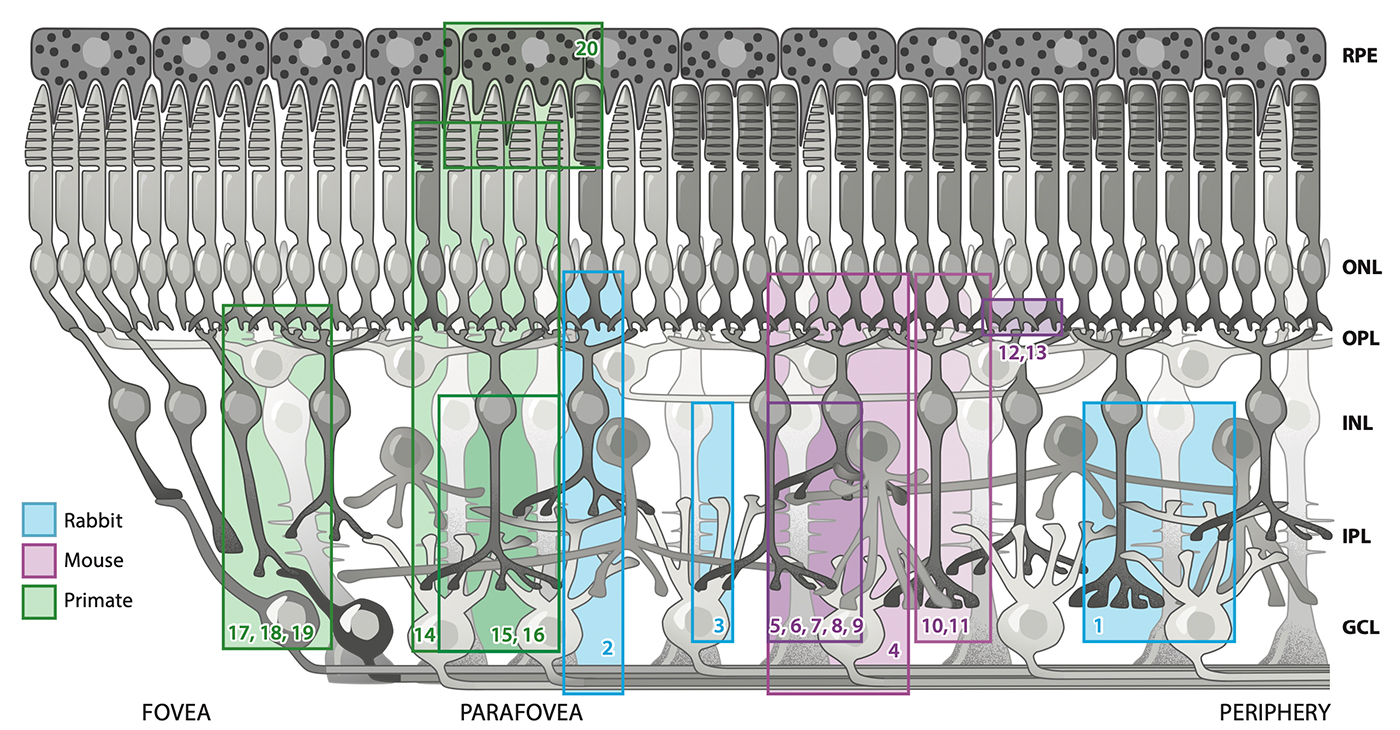
We have a new manuscript out of the lab in Volume 10 of the Annual Review of Vision Science titled Retinal Connectomics: A Review by Crystal L. Sigulinsky, Rebecca L. Pfeiffer, and Bryan William Jones. A .pdf is here.

Abstract
The retina is an ideal model for understanding the fundamental rules for
how neural networks are constructed. The compact neural networks of
the retina perform all of the initial processing of visual information be-
fore transmission to higher visual centers in the brain. The field of retinal
connectomics uses high-resolution electron microscopy datasets to map
the intricate organization of these networks and further our understand-
ing of how these computations are performed by revealing the fundamental
topologies and allowable networks behind retinal computations. In this ar-
ticle, we review some of the notable advances that retinal connectomics
has provided in our understanding of the specific cells and the organi-
zation of their connectivities within the retina, as well as how these are
shaped in development and break down in disease. Using these anatomi-
cal maps to inform modeling has been, and will continue to be, instrumental
in understanding how the retina processes visual signals.


Model-Based Comparison of Current Flow in Rod Bipolar Cells of Healthy and Early-Stage Degenerated Retina

We have a new manuscript out in Experimental Eye Research, Model-Based Comparison of Current Flow in Rod Bipolar Cells of Healthy and Early-Stage Degenerated Retina. (pdf here)

Authors: Pragya Kosta, Ege Iseri, Kyle Loizos, Javad Paknahad, Rebecca L. Pfeiffer @BeccaPfeiffer19, Crystal L. Sigulinsky @CLSigulinsky, James R. Anderson, Bryan W. Jones @BWJones, and Gianluca Lazzi.

Abstract: Retinal degenerative diseases, such as retinitis pigmentosa, are generally thought to initiate with the loss of photoreceptors, though recent work suggests that plasticity and remodeling occurs prior to photoreceptor cell loss. This degeneration subsequently leads to death of other retinal neurons, creating functional alterations and extensive remodeling of retinal networks. Retinal prosthetic devices stimulate the surviving retinal cells by applying external current using implanted electrodes. Although these devices restore partial vision, the quality of restored vision is limited. Further knowledge about the precise changes in degenerated retina as the disease progresses is essential to understand how current flows in retinas undergoing degenerative disease and to improve the performance of retinal prostheses. We developed computational models that describe current flow from rod photoreceptors to rod bipolar cells


Model-based Comparison of Current Flow in Rod Bipolar Cells of Healthy and Early-Stage Degenerated Retina