Monthly Archives: April 2021

Natural Immunoglobulin M-based Delivery of a Complement Alternative Pathway Inhibitor in Mouse Models of Retinal Degeneration

We have a new manuscript out in Experimental Eye Research, Natural Immunoglobulin M-based Delivery of a Complement Alternative Pathway Inhibitor in Mouse Models of Retinal Degeneration. (pdf here)

Authors: Balasubramaniam Annamalai, Nathaniel Parsons, Crystal Nicholson, Kusumam Joseph, Beth Coughlin, Xiaofeng Yang, Bryan W. Jones @BWJones, Stephen Tomlinson, and Bärbel Rohrer.

Abstract:

Purpose: Age-related macular degeneration is a slowly progressing disease. Studies have tied disease risk to an overactive complement system. We have previously demonstrated that pathology in two mouse models, the choroidal neovascularization (CNV) model and the smoke-induced ocular pathology (SIOP) model, can be reduced by specifically inhibiting the alternative complement pathway (AP). Here we report on the development of a novel injury-site targeted inhibitor of the alternative pathway, and its characterization in models of retinal degeneration.

Methods: Expression of the danger associated molecular pattern, a modified annexin IV, in injured ARPE-19 cells was confirmed by immunohistochemistry and complementation assays using B4 IgM mAb. Subsequently, a construct was prepared consisting of B4 single chain antibody (scFv) linked to a fragment of the alternative pathway inhibitor, fH (B4-scFv-fH). ARPE-19 cells stably expressing B4-scFv-fH were microencapsulated and administered intravitreally or subcutaneously into C57BL/6 J mice, followed by CNV induction or smoke exposure. Progression of CNV was analyzed using optical coherence tomography, and SIOP using structure-function analyses. B4-scFv-fH targeting and AP specificity was assessed by Western blot and binding experiments.

Results: B4-scFv-fH was secreted from encapsulated RPE and inhibited complement in RPE monolayers. B4-scFv-fH capsules reduced CNV and SIOP, and western blotting for C3a, C3d, IgM and IgG confirmed a reduction in complement activation and antibody binding in RPE/choroid.

Conclusions: Data supports a role for natural antibodies and neoepitope expression in ocular disease, and describes a novel strategy to target AP-specific complement inhibition to diseased tissue in the eye.

Precis: AMD risk is tied to an overactive complement system, and ocular injury is reduced by alternative pathway (AP) inhibition in experimental models. We developed a novel inhibitor of the AP that targets an injury-specific danger associated molecular pattern, and characterized it in disease models.

Keywords: Alternative pathway inhibitor; Choroidal neovascularization; Complement system; Encapsulated ARPE-19 cells; Natural antibody-mediated targeting; Smoke-induced ocular pathology.
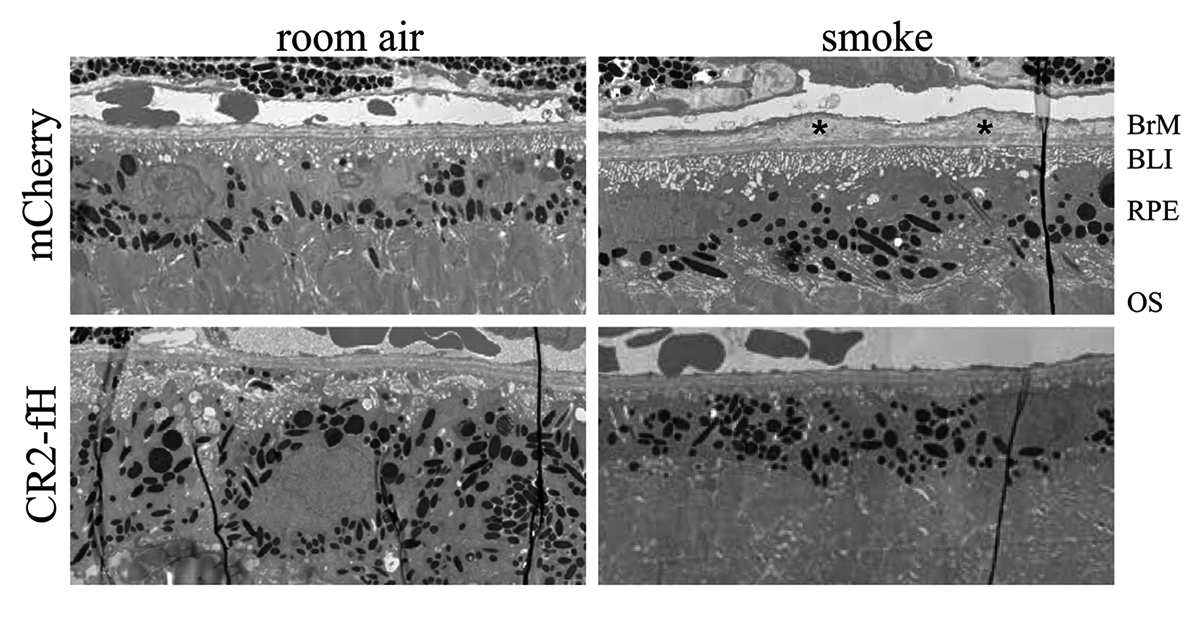
Subretinal Rather Than Intravitreal Adeno-Associated Virus–Mediated Delivery of a Complement Alternative Pathway Inhibitor Is Effective in a Mouse Model of RPE Damage

We have a new manuscript out in iOVS, Subretinal Rather Than Intravitreal Adeno-Associated Virus–Mediated Delivery of a Complement Alternative Pathway Inhibitor Is Effective in a Mouse Model of RPE Damage. (pdf here)

Authors: Balasubramaniam Annamalai; Nathaniel Parsons; Crystal Nicholson; Elisabeth Obert; Bryan W. Jones @BWJones; and Bärbel Rohrer.

Abstract:

Purpose: The risk for age-related macular degeneration has been tied to an overactive complement system. Despite combined attempts by academia and industry to develop therapeutics that modulate the complement response, particularly in the late geographic atrophy form of advanced AMD, to date, there is no effective treatment. We have previously demonstrated that pathology in the smoke-induced ocular pathology (SIOP) model, a model with similarities to dry AMD, is dependent on activation of the alternative complement pathway and that a novel complement activation site targeted inhibitor of the alternative pathway can be delivered to ocular tissues via an adeno-associated virus (AAV).

Methods: Two different viral vectors for specific tissue targeting were compared: AAV5-VMD2-CR2-fH for delivery to the retinal pigment epithelium (RPE) and AAV2YF-smCBA-CR2-fH for delivery to retinal ganglion cells (RGCs). Efficacy was tested in SIOP (6 months of passive smoke inhalation), assessing visual function (optokinetic responses), retinal structure (optical coherence tomography), and integrity of the RPE and Bruch’s membrane (electron microscopy). Protein chemistry was used to assess complement activation, CR2-fH tissue distribution, and CR2-fH transport across the RPE.

Results: RPE- but not RGC-mediated secretion of CR2-fH was found to reduce SIOP and complement activation in RPE/choroid. Bioavailability of CR2-fH in RPE/choroid could be confirmed only after AAV5-VMD2-CR2-fH treatment, and inefficient, adenosine triphosphate–dependent transport of CR2-fH across the RPE was identified.

Conclusions: Our results suggest that complement inhibition for AMD-like pathology is required basal to the RPE and argues in favor of AAV vector delivery to the RPE or outside the blood-retina barrier.

Model-Based Comparison of Current Flow in Rod Bipolar Cells of Healthy and Early-Stage Degenerated Retina

We have a new manuscript out in Experimental Eye Research, Model-Based Comparison of Current Flow in Rod Bipolar Cells of Healthy and Early-Stage Degenerated Retina. (pdf here)

Authors: Pragya Kosta, Ege Iseri, Kyle Loizos, Javad Paknahad, Rebecca L. Pfeiffer @BeccaPfeiffer19, Crystal L. Sigulinsky @CLSigulinsky, James R. Anderson, Bryan W. Jones @BWJones, and Gianluca Lazzi.

Abstract: Retinal degenerative diseases, such as retinitis pigmentosa, are generally thought to initiate with the loss of photoreceptors, though recent work suggests that plasticity and remodeling occurs prior to photoreceptor cell loss. This degeneration subsequently leads to death of other retinal neurons, creating functional alterations and extensive remodeling of retinal networks. Retinal prosthetic devices stimulate the surviving retinal cells by applying external current using implanted electrodes. Although these devices restore partial vision, the quality of restored vision is limited. Further knowledge about the precise changes in degenerated retina as the disease progresses is essential to understand how current flows in retinas undergoing degenerative disease and to improve the performance of retinal prostheses. We developed computational models that describe current flow from rod photoreceptors to rod bipolar cells


Model-based Comparison of Current Flow in Rod Bipolar Cells of Healthy and Early-Stage Degenerated Retina